For millions of homeowners, a mortgage is the single largest debt they’ll ever carry — which means even a small change in the interest rate can be worth tens of thousands of dollars over the life of the loan. That’s why mortgage refinancing remains one of the most powerful financial moves available to homeowners… when it’s done at the right time, for the right reasons.
This guide covers everything you need to decide whether a refinance makes sense for you in 2026: the types of refinancing available, the real costs involved, and the math that separates a smart refinance from an expensive mistake.
What Does Refinancing a Mortgage Actually Mean?
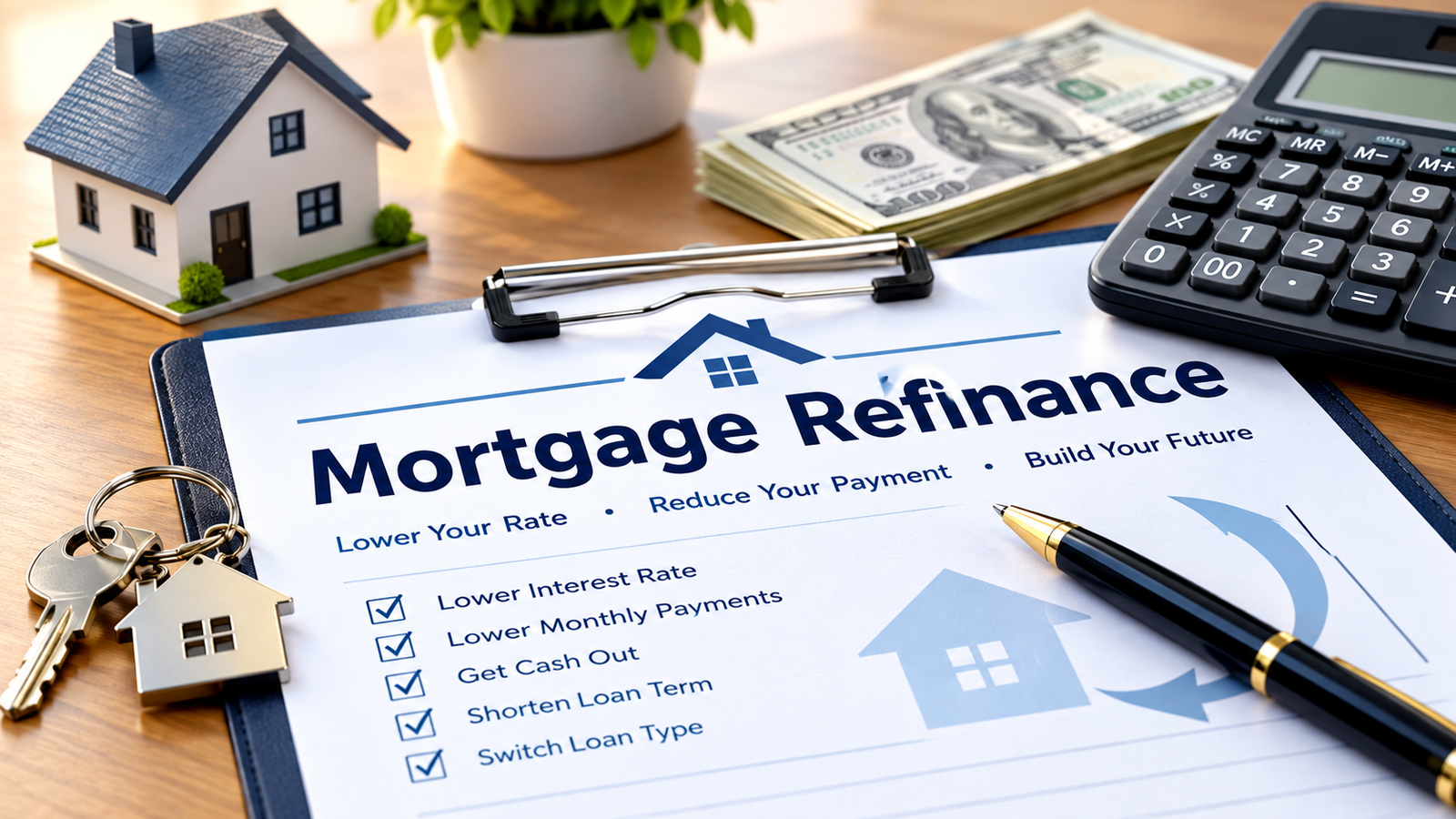
Refinancing means replacing your current home loan with a new one — ideally with better terms. Your new lender pays off your old mortgage, and you begin making payments on the new loan. Homeowners refinance to:
- Lock in a lower interest rate and reduce monthly payments
- Shorten the loan term (e.g., 30 years to 15) to pay off faster
- Switch from an adjustable-rate to a fixed-rate mortgage
- Tap home equity through a cash-out refinance
- Remove private mortgage insurance (PMI) once they have sufficient equity
The 4 Main Types of Mortgage Refinancing
1. Rate-and-Term Refinance
The classic refinance: you keep roughly the same loan balance but change the interest rate, term, or both. This is the go-to option when rates drop below what you’re currently paying.
2. Cash-Out Refinance
You take a new, larger loan and pocket the difference in cash. Homeowners use this for renovations, debt consolidation, or major expenses. The trade-off: you’re borrowing more, and your home secures the debt.
3. Cash-In Refinance
The opposite — you bring money to closing to shrink the loan balance. Common goals: eliminating PMI, reaching a better loan-to-value tier, or lowering the rate further.
4. Streamline Refinance
Government-backed loans (FHA, VA, USDA) offer streamlined refinance programs with reduced documentation and, in some cases, no new appraisal. VA borrowers, for example, have the Interest Rate Reduction Refinance Loan (IRRRL), and FHA offers its own streamline option.
The Break-Even Rule: The Most Important Math in Refinancing
Every refinance has costs — typically 2% to 6% of the loan amount in closing costs. So before refinancing, calculate your break-even point:
Break-even = Total closing costs ÷ Monthly savings
Example: Suppose refinancing costs you $4,800 in fees but saves $200 per month:
- $4,800 ÷ $200 = 24 months to break even
If you plan to stay in the home at least two years (and ideally much longer), the refinance likely makes sense. If you might sell within a year or two, you’d probably lose money.
A rate rule of thumb many borrowers use: refinancing is usually worth exploring when you can cut your rate by at least 0.5% to 1%, though the break-even math matters more than any fixed threshold.
When Refinancing Makes Sense
- Your rate is meaningfully above current market rates and the break-even period fits your timeline.
- Your credit has improved since you got your loan — better scores unlock better pricing.
- You want to escape an adjustable-rate mortgage before it resets.
- You can shorten your term without straining your budget — many borrowers who refinance from 30 to 15 years save enormous interest amounts while keeping payments manageable.
- You want to drop PMI — if your home’s value has risen, refinancing can get you below 80% loan-to-value and eliminate that monthly insurance cost.
- You’re consolidating expensive debt with a cash-out refinance at a much lower rate — with the discipline not to rebuild the debt.
When You Should Wait
- You plan to move soon. If the break-even point is beyond your expected time in the home, refinancing loses money.
- Your current balance is small. Closing costs hit small loans proportionally hardest; the savings may never justify the fees.
- You’re deep into your loan. Refinancing a 25-year-old loan into a fresh 30-year term resets amortization — early payments are mostly interest, so you often pay more total interest even at a lower rate. Consider a shorter term instead.
- Your credit score has dropped. You may not qualify for pricing that makes refinancing worthwhile. Improve your credit first, then refinance.
- Rate movement favors waiting. If rates are trending down and you’re not in a resetting ARM, there’s no penalty for waiting — you can refinance when the math improves.
Refinance Options Beyond the Standard Refi
If your first mortgage rate is excellent (say, locked in during a low-rate period), fully refinancing might mean giving up a great rate. Consider instead:
- Home equity loan — a fixed-rate second loan that leaves your first mortgage untouched.
- HELOC (home equity line of credit) — a flexible credit line against your equity; you borrow only what you need. Rates are typically variable.
Cash-out refinance vs. HELOC — quick comparison:
| Factor | Cash-Out Refinance | HELOC |
|---|---|---|
| First mortgage rate | Replaced with new rate | Kept intact |
| Rate type | Usually fixed | Usually variable |
| Best for | Large, one-time needs | Ongoing/flexible borrowing |
| Closing costs | Higher (2–6%) | Lower, sometimes minimal |
| Risk | Entire balance re-borrowed | Home still secures the line |
The Refinance Process, Step by Step
- Check your credit score and fix any errors before applying.
- Gather your numbers: current rate, remaining balance, term, and your home’s estimated value.
- Shop 3–5 lenders within a short window (typically 14–45 days) — credit scoring models treat clustered mortgage inquiries as one event. Compare rates, points, and official Loan Estimates side by side.
- Lock your rate once you’re satisfied — rate locks typically last 30 to 60 days.
- Complete underwriting: expect income verification, an appraisal (or waiver), and documentation of assets.
- Close and breathe. You generally have a federally mandated 3-day right of rescission on a primary-home refinance before the loan finalizes.
How to Shave Your Rate Even Lower
- Buy points — paying upfront discount points lowers your rate; the math works if you’ll keep the loan past the break-even.
- Improve your credit tier — even a one-tier score improvement can meaningfully cut pricing.
- Shorten the term — 15-year loans carry lower rates than 30-year loans.
- Consider community lender deals — banks and credit unions sometimes run relationship discounts.
Frequently Asked Questions
How much does it cost to refinance a mortgage?
Typically 2% to 6% of the loan amount, covering appraisal, origination, title, and recording fees. Some lenders offer “no-closing-cost” refinances that roll fees into the loan or a slightly higher rate.
How long does a refinance take?
Usually 30 to 45 days from application to closing, though streamlined programs can be faster.
Can I refinance with bad credit?
Conventional refinancing generally wants a solid mid-range score or better; FHA streamline and VA IRRRL programs are more forgiving. Improving your score even slightly before applying can pay off significantly.
How much equity do I need to refinance?
For a standard rate-and-term refinance, 20% equity avoids PMI. Many programs allow refinancing with less equity, though terms may be less favorable. Cash-out refinances typically require retaining 15%–20% equity after the transaction.
Does refinancing restart my loan term?
It can, if you choose the same term length as your original loan. You can avoid this by refinancing into a shorter term that matches (or beats) your remaining timeline.